Residential ventilation
Everything at a glance
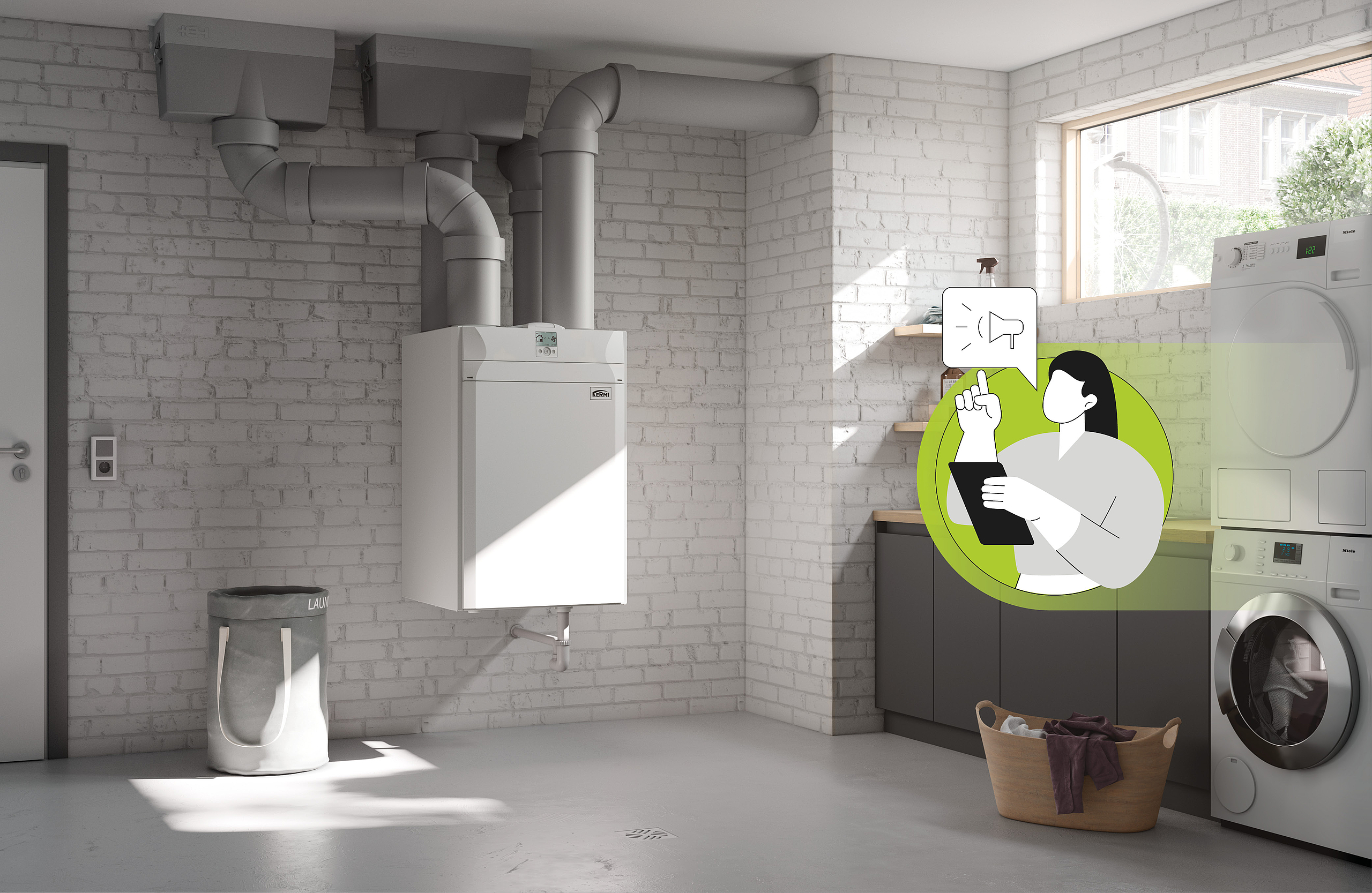
To supply the house with fresh air, you regularly open the windows. However, proper ventilation is much more convenient and reliable with residential ventilation. Whether as a centralised or decentralised ventilation system, it ensures the necessary air exchange in the house to prevent mould and improves the indoor climate and air quality. A compact explanation of how this works and what is important.
At a glance
- Residental ventilation means that fresh air enters the rooms and stale air is extracted to the outside.
- Why is controlled ventilation so important? If buildings are well insulated, mould can easily form without ventilation.
- Residential ventilation: Centralised ventilation system for the whole house or decentralised ventilation units for each room.
- Added comfort thanks to efficient heat recovery and air filters.
- Advantages of residental ventilation: Healthy indoor climate, energy savings and optimum air quality in the room without draughts or noise.
- Costs & maintenance: Advantages justify acquisition costs; operating costs and maintenance costs are low.
What is meant by residental ventilation?

Residental ventilation is the supply of fresh air to indoor spaces and the removal of stale air and excess humidity - important for a healthy indoor climate.
There are basically two options:
- Manual ventilation: traditionally, ventilation is achieved by manual ventilation, i.e. opening windows and doors, for example by airing the room in bursts. However, this method is heavily dependent on user behaviour and can lead to considerable heat loss.
Mechanical ventilation: A modern alternative to manual ventilation is mechanical ventilation in the home. Here, a fan-assisted ventilation system ensures a controlled exchange of air - often with efficient heat recovery from the extract air. In this way, residental ventilation systems help to regulate the indoor climate and humidity.
A distinction is made between two systems: centralised ventilation systems and decentralised ventilation systems.
Why is residential ventilation becoming increasingly important?
- Better building insulation: To avoid heat loss, the building envelope is becoming increasingly tight. This severely restricts the natural circulation of air, e.g. via cracks and joints. As a result, humidity, such as that produced when cooking and showering, but also when breathing, can no longer escape. Manual ventilation is often not enough to ensure a healthy indoor climate.
- Avoiding mould growth: Without sufficient ventilation, the risk of mould growth increases, which can affect both the building fabric and the health of the occupants. A residental ventilation system, whether centralised or decentralised, automatically replaces the air and removes moisture.
- Legal requirements: DIN 1946-6 specifies binding requirements for the ventilation of homes and also minimum ventilation rates. Residential ventilation is a proven means of reliably fulfilling these requirements.
- Energy efficiency in new builds and existing buildings: Residential ventilation with heat recovery plays a decisive role in new builds and energy refurbishments in order to save heating energy and reduce energy consumption.
Centralised residental ventilation: how it works
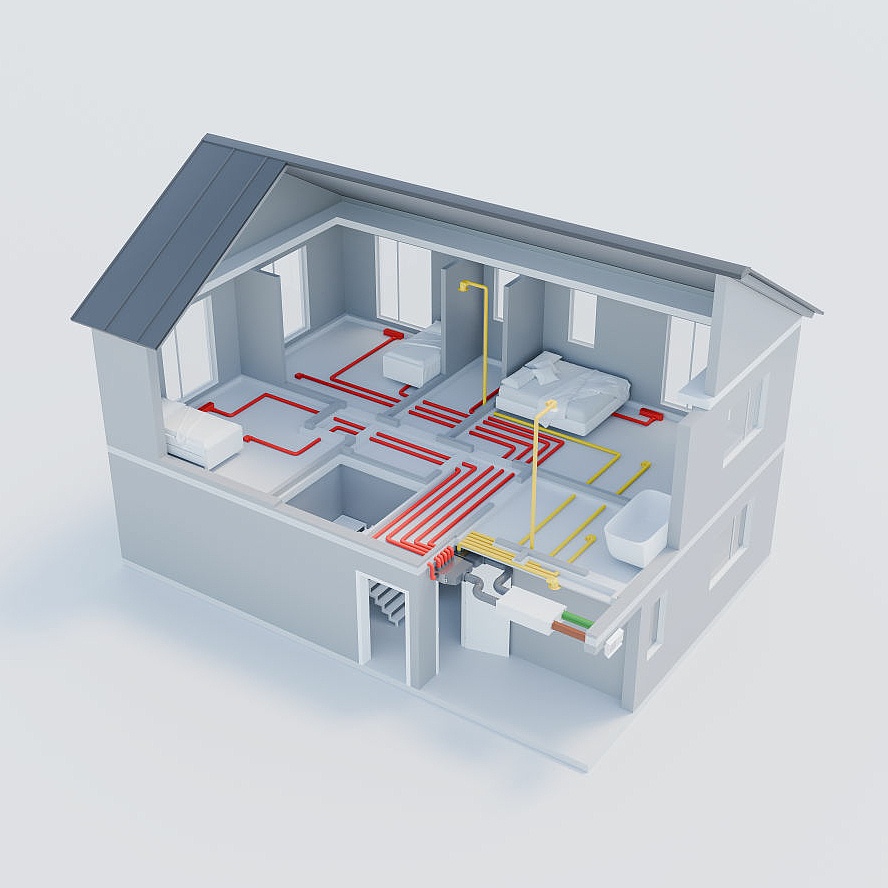
A centralised residental ventilation system consists of
- one central ventilation unit per housing unit
- Supply and exhaust air ducts to the rooms or from the rooms to the ventilation unit
- Air outlets into the room
- Air ducts between the outer wall and the ventilation unit
Functional principle of centralised residental ventilation:
- The centralised ventilation unit draws in outside air (green) using fans, filters it and preheats it.
- The supply air (red) then flows into the rooms, usually bedrooms and living rooms. From there, the air manifolds throughout the house.
- The extract air (yellow), i.e. stale air with moisture, odour particles and CO2, is usually extracted from typical extract air rooms such as the bathroom and kitchen.
- The ventilation unit then discharges it to the outside as exhaust air (brown).
This cycle between outside air, supply air, extract air and exhaust air takes place quietly and without draughts. This creates effective air circulation throughout the house, which contributes to a healthy indoor climate.
Advantages of centralised ventilation systems
- Optimum air manifold in the house
- Height heat recovery
- Demand-led control of the ventilation
- Air filter and pollen filter
Decentralised residental ventilation: possibilities and function
With decentralised residental ventilation, a small, decentralised ventilation unit is installed in each room that needs to be ventilated - usually directly in the outer wall. There are solutions with efficient heat recovery as well as simpler ventilation variants.
Version 1: Decentralised ventilation system using the pendulum principle
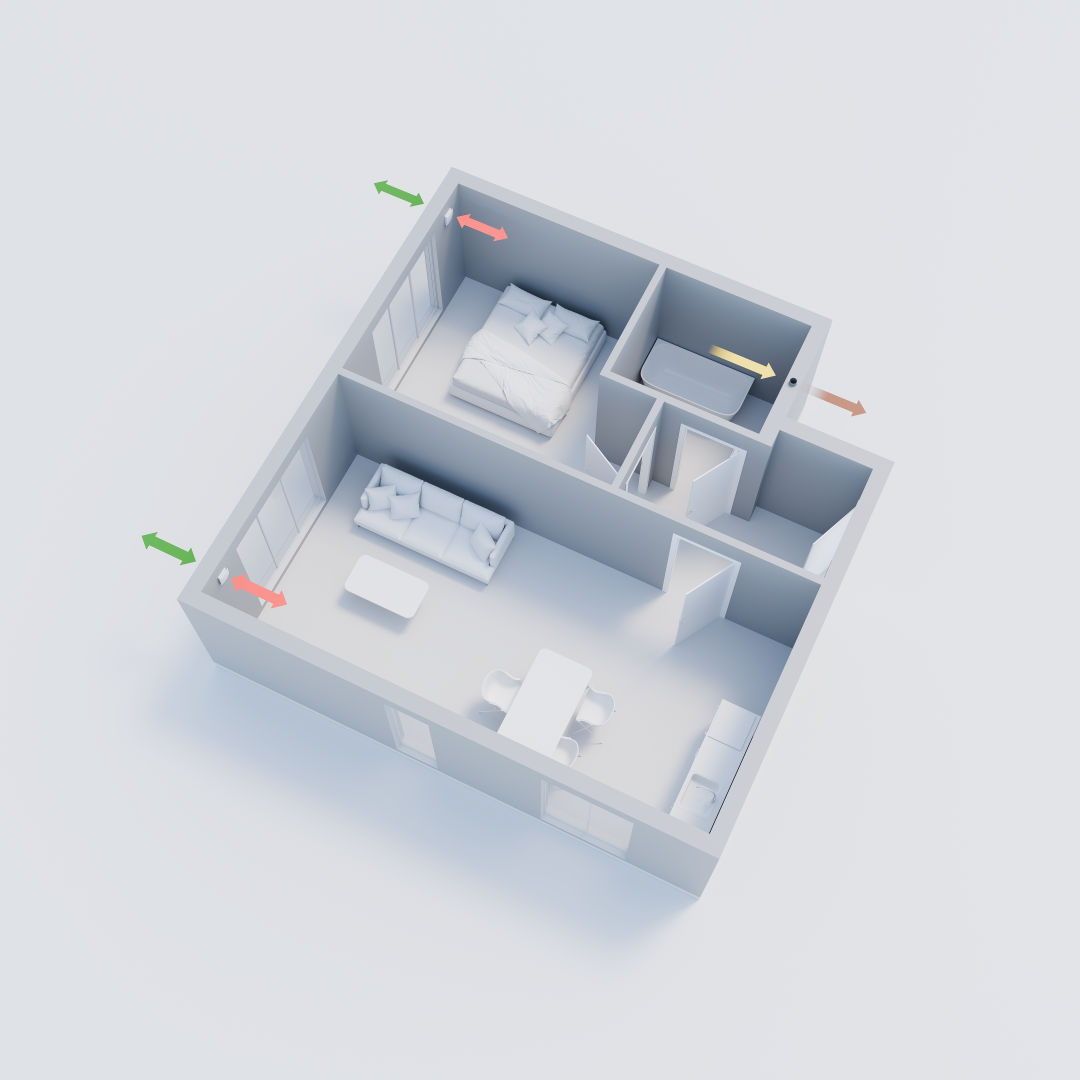
For air exchange using the pendulum principle, there is a pendulum fan in the outer wall of each room.
Functional principle of pendulum fans
- Fans in ventilation units alternately draw in fresh outside air, filter it and temper it through heat recovery.
- It is then discharged into the room as supply air.
- The used extract air and humidity is then discharged from the room as exhaust air.
Advantages of decentralised ventilation systems using the pendulum principle
- Demand-led air exchange
- Installation without ventilation pipes, therefore usually easy to retrofit
- Efficient heat recovery
- Air filter and pollen filter
Version 2: Simple ventilation system
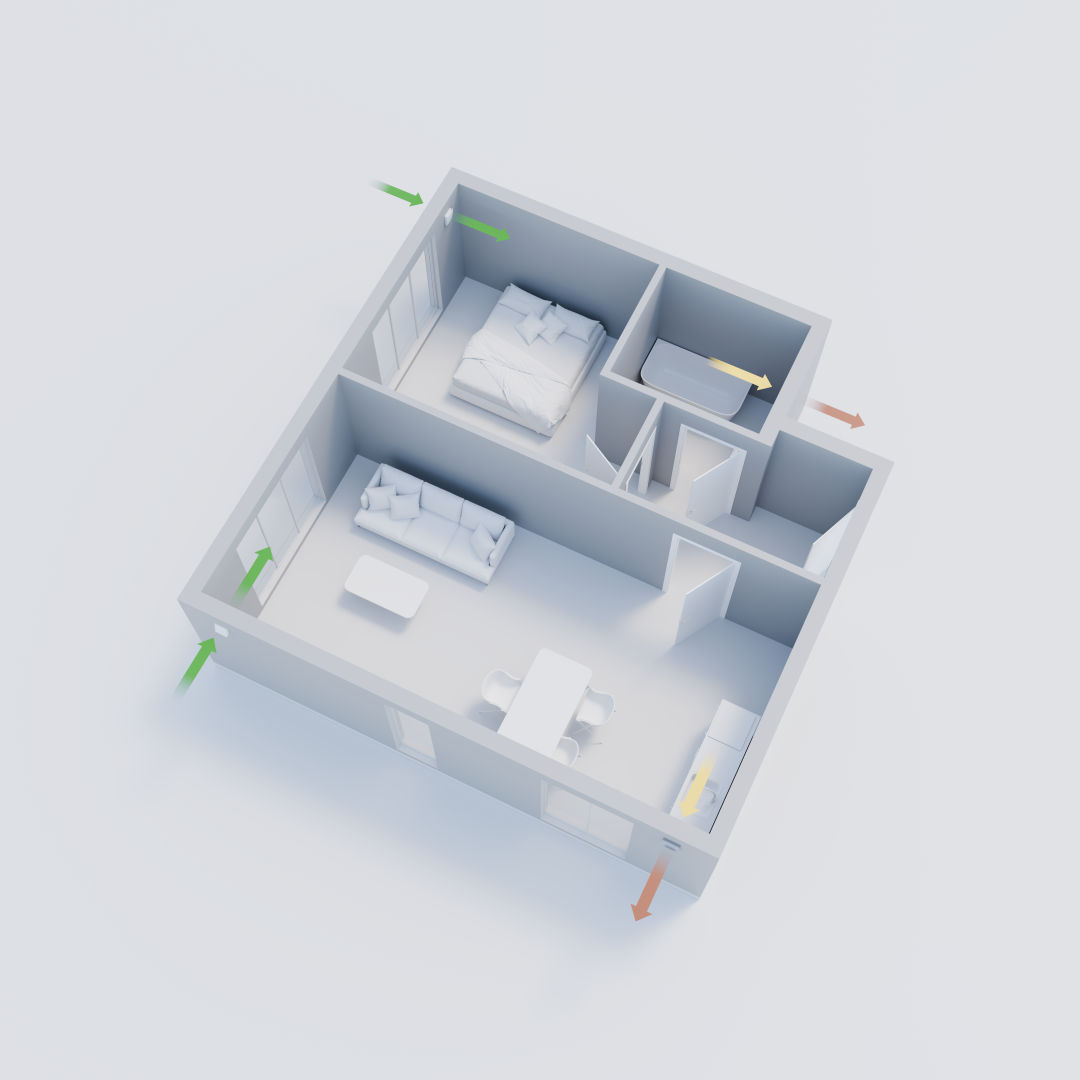
The simplest version of decentralised residental ventilation consists of
- Outer wall air vents for ventilation: These are installed in the outer wall of supply air rooms (e.g. living room and bedroom) and ensure a natural air flow without fans.
- Small room fans or single-pipe fans for bleeding / venting: With the help of fans, they draw in stale air, odours and moisture in the typical extract air rooms (e.g. bathroom and kitchen) and transport them outside. To do this, the fans are mounted directly in the outer wall of the room or connected to a ventilation pipe to the outside.
The combination of air vent and fans creates simple but continuous aeration and bleeding / venting across the various rooms.
Advantages of simple, decentralised ventilation systems
- Continuous air exchange
- Simple installation
- Cost-effective ventilation and extraction solution
Disadvantages
- No heat recovery
- No demand-led control
Tip for retrofitting a residental ventilation system
Would you like to benefit from the advantages of residential ventilation in an existing building? Decentralised residental ventilation systems are relatively easy to retrofit using core drilling. However, centralised ventilation systems can also often be retrofitted without any problems - even if there is no separate basement or plant room available.
There are particularly compact or flat ventilation units for this purpose, which can also be installed within the living area, e.g. in cupboards, pre-wall installations or suspended ceilings. Special flat ventilation pipes, which lead from the ventilation unit into the rooms, disappear invisibly into a suspended ceiling.
Efficient principle of heat recovery
Whether centralised or decentralised, residential ventilation systems with heat recovery are particularly efficient. They utilise the heat from the extract air to preheat the supply air. To do this, the heat is transferred to the incoming air via a heat exchanger. In this way, up to 90 % of the heat can be recovered. This ensures that the rooms do not cool down, thus reducing the heating energy requirement and making a decisive contribution to energy efficiency in new builds and renovated buildings.
You can find out more about the function, benefits and installation of residental ventilation systems with efficient heat recovery here.
Air filters and pollen filters - breathing easy, not just for allergy sufferers
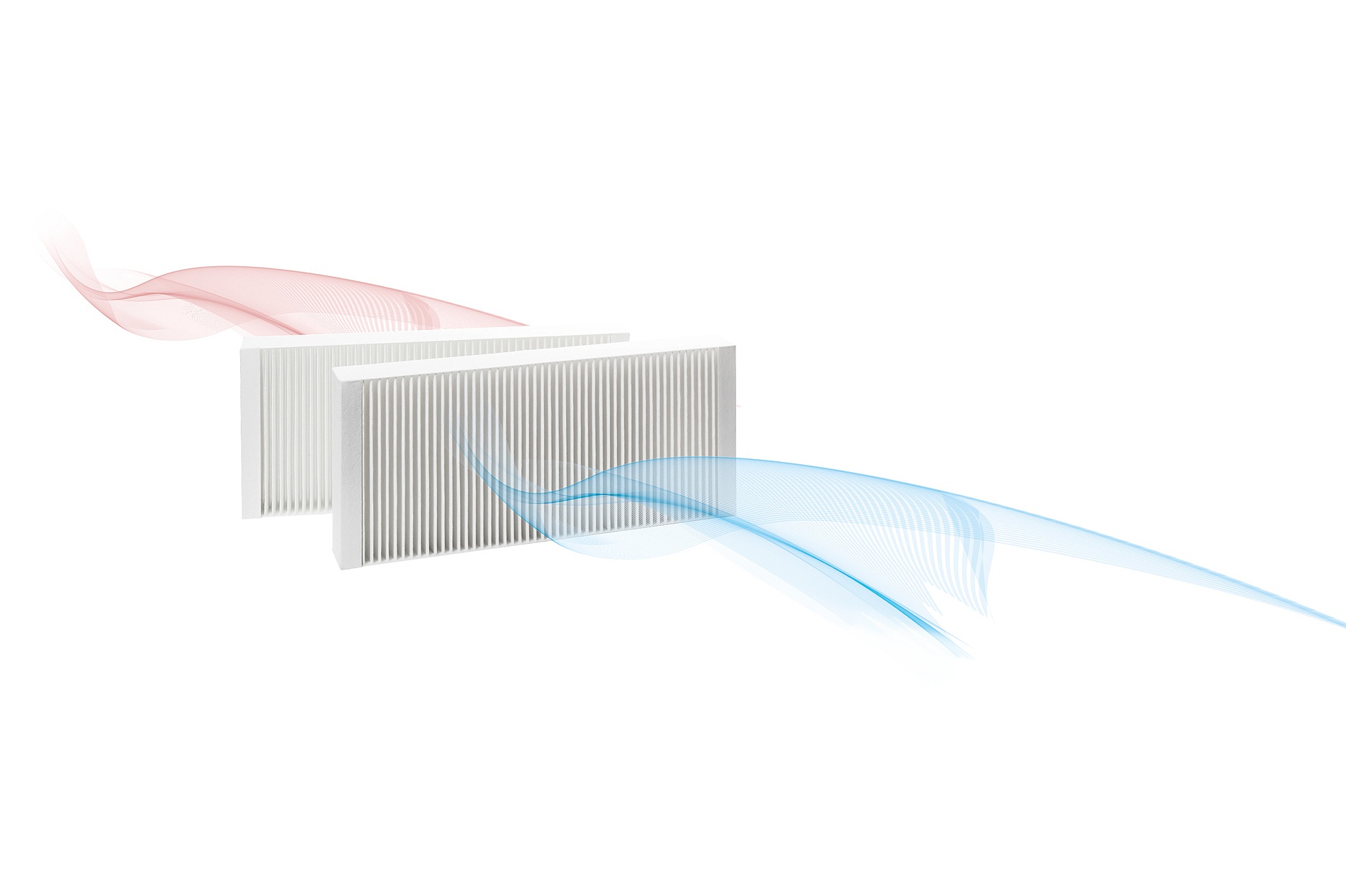
Depending on the living environment, the outside air can be contaminated with various pollutants and pollen, for example from agriculture or car exhaust fumes.
With a ventilation system, these do not enter the house during air exchange: high-quality air filters in the ventilation units filter pollen, pollutants and also germs, viruses and bacteria from the outside air before it flows into the living rooms as supply air.
If the outside air is particularly polluted, special hygiene filters can also be used to further improve the air quality.
Advantages of residental ventilation
- The rooms are supplied with fresh air around the clock without windows having to be opened or tilted.
- Stale air with an increased CO2 content, pollutants and unpleasant odours is reliably removed, improving the air quality in the room.
- Humidity is regulated, preventing mould growth.
- Heating requirements are reduced thanks to efficient heat recovery.
- Thanks to high-quality fresh air filters, pollen and pollutants do not enter the house.
- As the windows remain closed during air exchange, noise pollution from outside is reduced and burglary protection is increased.
- Residential ventilation systems work particularly quietly with modern fan technology and also remain visually in the background.
What does residential ventilation cost?

- The installation of a residental ventilation system in a detached house with 150 square metres of living space can be expected to cost around 5,500 to 7,000 euros - without any structural measures on the building. From a cost perspective, it generally makes little difference whether it is a centralised or decentralised ventilation system - although it always depends on the device selected.
- The electricity costs for operating the above-mentioned single-family home amount to just a few euros per year.
The initial investment costs for the installation of a residental ventilation system pay off twice for homeowners in the long term. On the one hand, residental ventilation helps to prevent mould and thus damage to the building fabric, which often results in costly refurbishments. Secondly, residental ventilation with heat recovery reduces heat losses in the building and can therefore noticeably reduce heating costs. In this way, you protect your home effectively and save energy costs in the long term.
Maintaining residental ventilation:
This must be observed
Filters should be changed regularly (approximately every 180 days): Central ventilation units indicate when it is time to change the filter.
It is not usually necessary to clean the ducts, as filters for the outside and extract air prevent dirt deposits in the ducts and the external filters also significantly reduce the entry of dirt and pollen.
The ventilation system should be serviced by a specialist partner every 2 years.
FAQ
What is the difference between controlled and free ventilation?
With free ventilation, air exchange occurs naturally. Fresh air enters rooms through cracks, but mainly through manually opening windows, and stale air escapes. This type of ventilation is simple, but highly dependent on user behaviour and can lead to heat loss.
Controlled residential ventilation, on the other hand, works mechanically: fans in the ventilation unit ensure continuous air exchange. The fresh air is filtered and often tempered with heat recovery. This saves energy and ensures a consistently good indoor climate – regardless of whether the windows are open or not.
Does controlled residential ventilation help prevent mould growth?
Yes, controlled residential ventilation plays a key role in preventing mould growth. This is because it continuously removes humid, stale air to the outside. This helps to prevent moisture from accumulating on cold surfaces, which are often a breeding ground for mould. Controlled ventilation is particularly important for preventing mould in modern, well-insulated and airtight buildings where natural air circulation is restricted.
Are ventilation systems beneficial for allergy sufferers?
Yes, ventilation systems are particularly useful for allergy sufferers. High-quality filters in the ventilation units filter pollen, dust and pollutants from the outside air before it enters the living spaces. This contributes to good indoor air quality in general and can reduce exposure, especially for pollen allergy sufferers.
How loud is a controlled residential ventilation system when in operation?
The noise level of a controlled residential ventilation system depends on many factors, such as the ventilation unit selected, the length of the air ducts, the outlet, the volume of air transported and the room design, including flooring, wall design and furnishings. Since all these individual factors influence the sound pressure level, it is not possible to specify universal noise values.
In principle, however, a central ventilation system operates very quietly; it is no louder than a whisper or the soft rustling of leaves. With decentralised ventilation, the noise level is usually slightly higher. In terms of volume, it is similar to a ticking clock or quiet breathing.
Can you retrofit a ventilation system in an old building?
Yes. Decentralised ventilation systems in particular can usually be retrofitted quite easily: the ventilation units are simply installed directly in the outer wall of the individual rooms using core drilling.
Central ventilation systems can also be retrofitted, but often require a little more construction work as ventilation pipes have to be laid. However, there are particularly flat duct systems available especially for renovation projects, which can be installed in suspended ceilings. Compact ventilation units can then be housed in cupboards, pre-wall installations or also in suspended ceilings, for example.